Frailty (2001): Divine Mission or Deadly Delusion?
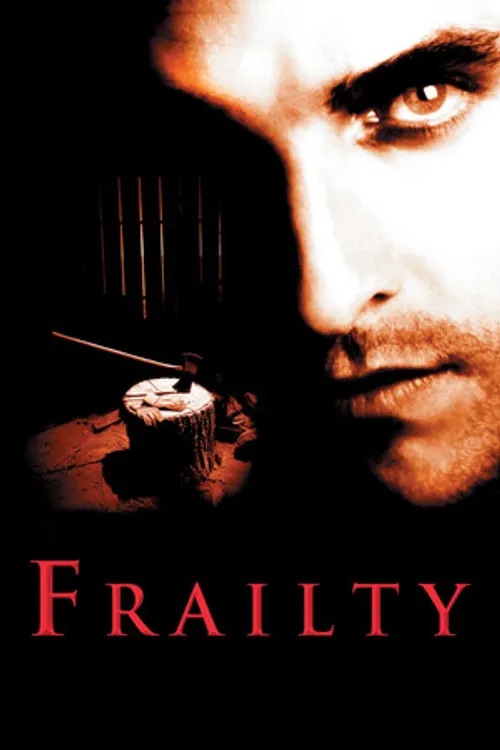
Frailty is one of those rare horror films that doesn’t just scare you—it makes you question what you’re actually watching. Is this a supernatural thriller about demon hunters chosen by God? A psychological breakdown of a family torn apart by religious mania? Or just a really compelling argument for why you should never let your dad build a shed? Directed by Bill Paxton in his directorial debut,
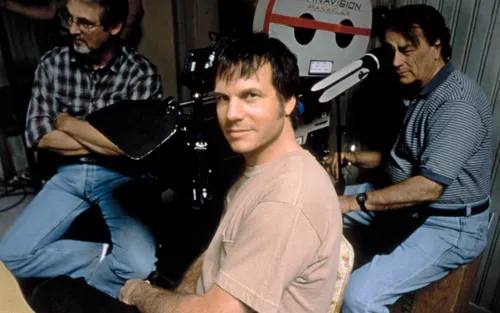
this 2001 film stars Paxton as a widowed mechanic raising two sons in small-town Texas. Matthew McConaughey plays the adult Fenton Meeks, who walks into an FBI office one night with a story about his brother being the notorious God’s Hand serial killer. What unfolds is a narrative that constantly keeps you guessing about what’s real and what’s madness.
The Setup
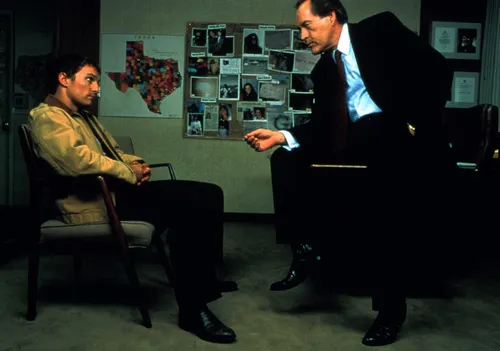
The movie opens with Fenton arriving at the FBI office to speak with Agent Wesley Doyle (Powers Boothe). He claims his brother called him in a panic about “too many demons” before apparently taking his own life. To explain how he knows his brother is the killer, Fenton takes Doyle, and us, back to 1979.
Back then, Fenton and his younger brother Adam were living a normal life with their mechanic father. Everything was fine until their dad burst into their room one night claiming he’d had a vision. An angel appeared to him, via his bowling trophy, naturally, and revealed that demons walk among us disguised as regular people. God has chosen their family to destroy these demons, and divine weapons are on the way.
Adam is fascinated. Fenton is horrified.
When “Divine Weapons” Arrive
Sure enough, Dad starts finding his holy arsenal: an axe (eventually named Otis), a lead pipe, and a pair of work gloves. The gloves, he explains, let him see demons as humans so he can approach them. When he takes the gloves off and touches them, he sees their true demonic nature and whatever sins they’ve committed.
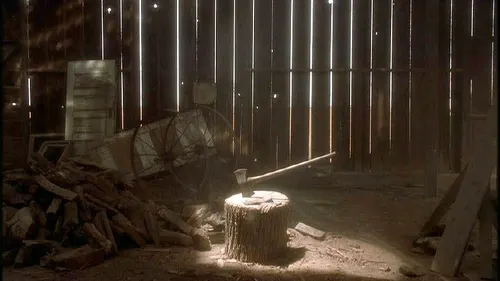
The movie does an impressive job keeping you uncertain. When Dad has his “visions,” there’s always a mundane explanation nearby—sparks from a grinder that could look like a flaming sword, sunlight through a barn that could just be coincidence. Is God really guiding this man, or is he just catastrophically mentally ill? Fenton knows what he thinks: his dad has lost his mind, and he needs to tell someone before people get hurt.
The First Kill
Dad brings home their first “demon,” a woman, still alive, terrified, with duct tape over her mouth. Adam watches eagerly as their father removes his gloves, touches her head, and appears to receive some kind of electric shock while “seeing” her sins. Then he picks up the axe.
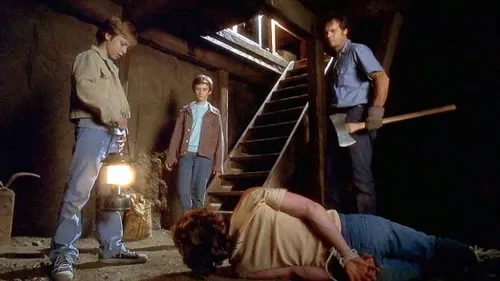
Fenton screams for him to stop. We don’t see the killing, but we know it happens. Afterward, they bury her in pieces in the Rose Garden behind their house. Adam seems totally fine with it. Fenton is traumatized.
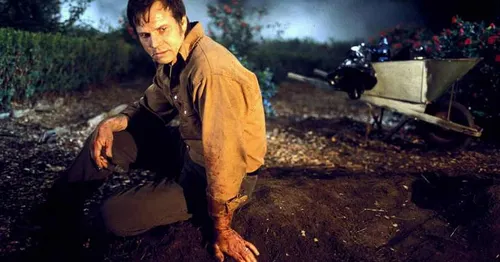
This pattern continues. Dad gets names from his divine list, they abduct people, and the family buries bodies in the garden. The film never shows the actual moment of death, just the before and after, which somehow makes it worse.
The Cellar
After a couple of kills, Dad makes Fenton dig an enormous hole that is 10 feet deep, 15 feet wide. It takes five days of backbreaking labor with blistered, bleeding hands. Then they build a cellar in that hole and move the shed over it, creating an underground dungeon accessible through a trapdoor in the shed floor.
Fenton’s Impossible Choice
Fenton tries to get his younger brother to run away with him, but Adam is a true believer. He’s seen the demons too when Dad touches them. Or at least he thinks he has. It’s never entirely clear if Adam genuinely experiences these visions or if he’s just so desperate to please his father that he’s convinced himself. When Fenton finally works up the courage to go to the sheriff, it backfires spectacularly. The sheriff comes to their house, checks the cellar, finds nothing suspicious, and is about to leave when Dad hits him with the axe on the stairs. The sheriff tumbles back down, still alive. This is different from the “demons”—Dad is devastated. There’s blood everywhere. He’s never killed a person before, only demons. And it’s all Fenton’s fault.
Dad finishes killing the sheriff with the axe. Then he locks Fenton in the cellar as punishment—one cup of water a day, no food. Fenton stays down there for weeks until he’s barely conscious and finally claims to have seen God.
Whether that vision was real, a hallucination from starvation, or a survival lie is left for you to decide.
The Twist Within the Twist
Dad eventually asks Fenton if he’s ready to kill a demon himself. They abduct a man, bring him to the cellar, and Dad hands Fenton the axe. But when the moment comes, Fenton swings at his father instead, burying the axe in his chest. Adam watches his father die, and you can see the hatred in his eyes when he looks at Fenton. But before anyone can react, Adam grabs the axe and kills the man who was tied up—the “demon” his father had brought home.
The brothers bury their father in the Rose Garden and eventually go to separate orphanages.
The Big Twist
Here’s where the movie earns its reputation. The man who’s been telling Agent Doyle this story isn’t Fenton…it’s Adam. Adam killed the real Fenton and then went to the FBI pretending to be his brother. Adam is the one who’s been carrying on Dad’s work, destroying demons. Fenton never became a killer—he became Adam’s target.
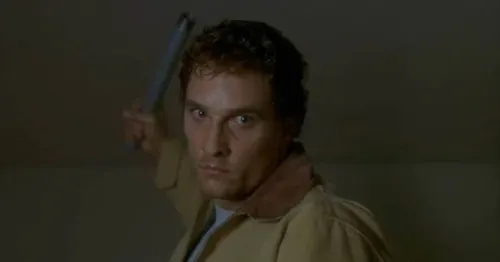
But it gets weirder. When Adam touches Agent Doyle, he sees a vision of Doyle murdering his own mother. Doyle knows—somehow knows—that Adam just saw what actually happened. There’s no way Adam could have known those details unless something supernatural is going on.
Then Adam kills Doyle and buries him in the Rose Garden.
The FBI tries to investigate, but every security tape of Adam’s face is mysteriously blurred. No one can remember what he looks like. And when an agent shows up at the sheriff’s office in Adam’s small town to inform him about his brother, he shakes Adam’s hand and walks away with no idea who he just met. The film ends with Adam, now the local sheriff, married and expecting a child, standing outside his office. The family business will continue.
So What’s the Truth?
This is where Frailty really gets under your skin. The movie presents compelling evidence for both interpretations. Evidence Dad was just insane: The visions always have mundane explanations. The “demons” are just regular people. Fenton never sees anything supernatural until he’s starving to death in a cellar. Mental illness can absolutely run in families.
Evidence it’s actually divine intervention: The security footage is corrupted. FBI agents can’t remember Adam’s face. Adam knows details about Doyle’s mother’s murder that he couldn’t possibly know. When Dad kills demons, there’s no blood, but when he kills the sheriff, blood is everywhere. And the flashbacks show that the “demons” Adam’s father killed actually were guilty of terrible crimes.
The genius of the film is that it never definitively picks a side. You can walk away convinced it’s either a supernatural horror or a psychological one, and both readings are valid.
The Craft of It All
Bill Paxton’s direction is restrained and effective. He keeps the violence mostly off-screen, which makes it more disturbing rather than less. The performances are uniformly strong—McConaughey playing dual roles without being showy about it, and the child actors (Matt O’Leary and Jeremy Sumpter) selling the terror and confusion of their situation. The script by Brent Hanley was written during a difficult period in his life and loosely inspired by real cases of people claiming divine instruction for murder. The title “Frailty” refers to the fragility of human perception—how easily our grasp on what’s real can slip.
The Verdict
We’re giving Frailty 8.5 cents out of 10.
This is a smart, unsettling film that respects its audience enough to let them draw their own conclusions. It’s a horror movie that works whether you think it’s about demons or delusion, or somehow both at once.
The ending is particularly brilliant. Adam has a wife who seems to know exactly what he does. She’s pregnant. The cycle will continue. Whether that’s a family of demon hunters carrying out God’s work or a lineage of serial killers passing down their psychosis depends entirely on which version of this story you believe.
And that’s what makes Frailty stick with you long after the credits roll. It’s not about jump scares or gore. It’s about the terrifying possibility that the scariest monsters might be the ones who think they’re heroes.
If someone ever tell you they have a divine list, run.