Leviathan (1989): 16,000 Feet Down and Corporate Still Somehow Found a Way to Make It Worse
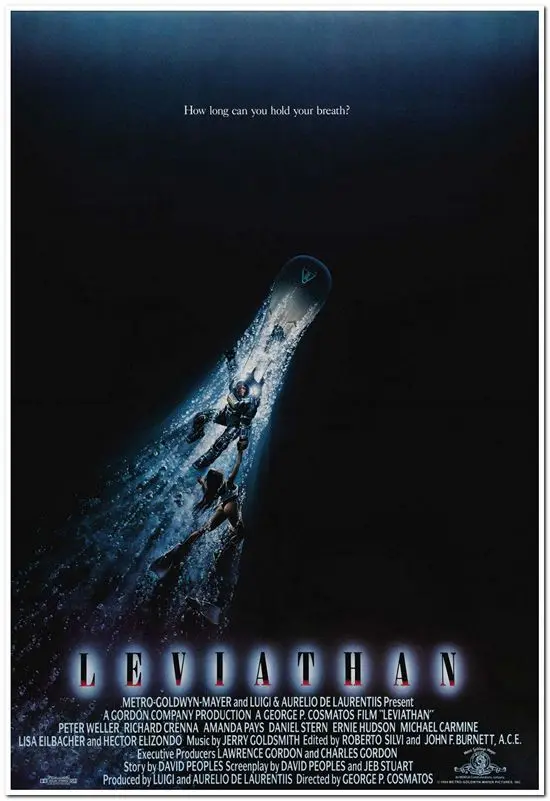
There are plenty of bad places to discover that your employer considers you expendable.
Sixteen thousand feet beneath the Atlantic Ocean feels especially rude.
Leviathan takes a crew of exhausted deep-sea miners, gives them three days until the end of a ninety-day shift, drops a genetically engineered Soviet nightmare into their habitat, and then reminds them that the monster may not actually be the least trustworthy thing down there.
Because sea creatures can only eat you.
Corporate can put it in writing first.
Three Days Until Freedom, Assuming Nobody Mutates
The crew of Tri-Oceanic Mining Shack 7 is nearing the end of an extremely hazardous mission extracting silver and other precious metals from the Atlantic floor. Day 87 of 90 has arrived, which means everyone is tired, irritated, and psychologically already packing.
Their reluctant leader is Steven Beck, a geologist who has somehow been promoted into command and appears to be learning management from The One Minute Manager. Talon found the sight of him flipping through the book particularly reassuring. Nothing inspires confidence sixteen thousand feet underwater like realizing the captain is cramming for leadership between emergencies.
The crew includes Dr. Glen Thompson, whose attitude suggests being physically present for his job is more of a recommendation; Willie Williams, an engineer preparing for astronaut training; veteran mechanic Cobb; Bowman; DeJesus; Justin Jones; and Buzz “Sixpack” Parrish, played by Daniel Stern.
It is a strong ensemble, and the movie gives them enough personality that they feel like people who have actually spent almost three months trapped together. They tease each other, steal liquor, argue about work, complain about Beck, and have developed the specific irritation that comes from knowing exactly which coworker will annoy you before that person even opens his mouth.
Sixpack is exactly the sort of obnoxious, crude 1980s character whose continued employment feels like a workplace investigation waiting to happen. Dan disliked him immediately, though both of us agreed the performance succeeds precisely because Sixpack is supposed to be irritating.
The first crisis belongs to DeJesus, whose diving suit malfunctions on the ocean floor. His oxygen drops, pressure builds, and Beck scrambles around the control room trying to keep him alive while Doc is nowhere near his station.
DeJesus barely makes it back.
Which leads Dan to an important theological discovery.
DeJesus appeared to die and then came back.
Jesus has officially been resurrected.
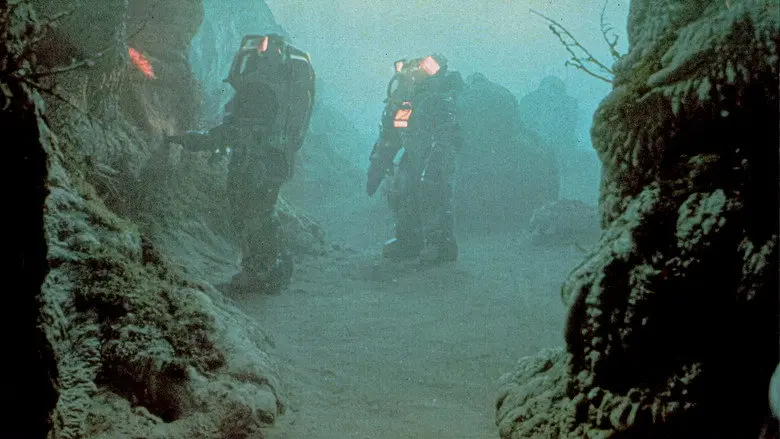
The crew settles back into its normal rhythm of grudges, maintenance, crude jokes, and apparently repairing vital underwater machinery with chewing gum.
The gum works.
We are going to remember that.
The Soviet Ship With Absolutely Nothing Suspicious Inside
Sixpack and Willie are sent outside for another mining shift when Sixpack falls into a crevice and loses radio contact.
Willie goes after him and finds something much more interesting than ore: a sunken Soviet vessel called Leviathan.
Inside are skeletal remains, a captain’s log, personnel records stamped deceased, and a large container Sixpack proudly drags back to the station because horror movies depend on people seeing a mysterious wreck full of dead bodies and thinking, “We should bring some of this home.”
The recovered material gets stranger.
Records show that Leviathan is supposedly still an active Soviet ship in the Baltic Sea, despite the inconvenient fact that Willie just filmed it rotting on the bottom of the Atlantic. The hull also appears to have been deliberately destroyed, possibly by a torpedo.
The captain’s videotaped log describes a mysterious illness spreading through his crew.
That should be enough.
It is not enough.
Sixpack also secretly steals a flask of vodka from the wreck.
Later he shares it with Bowman.
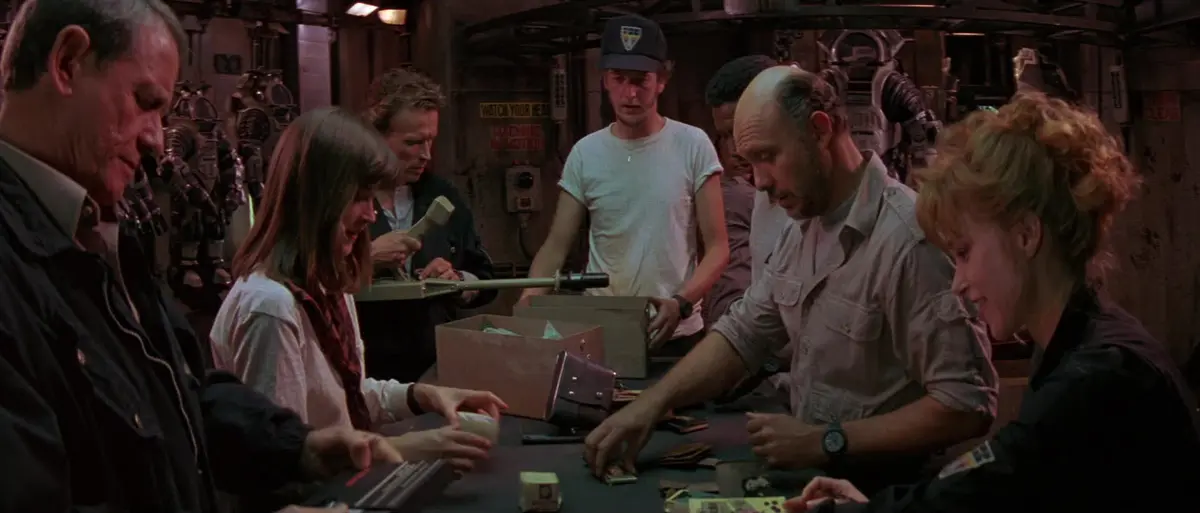
The crew has now found a ship full of corpses, learned everyone aboard suffered from an unexplained disease, and decided the mystery liquor deserves a tasting.
Dan and Talon were less concerned about whether vodka technically expires and more interested in the fact that it came from a plague ship.
Expiration date feels secondary.
The next morning Sixpack develops lesions and bruising across his back. Doc examines a tissue sample and his remarkably advanced computer quickly begins suggesting genetic alteration.
Talon was impressed. This is 1989 artificial intelligence apparently diagnosing mutations from a microscope while modern printers still occasionally need to be unplugged twice before admitting they contain paper.
Within hours, Sixpack is dead.
Then Bowman gets sick too.
Her hair begins falling out. She discovers the hideously altered Sixpack under a sheet, realizes the same thing is happening to her, and later kills herself in the shower.
Beck and Doc request an emergency evacuation, but Martin claims a hurricane off Cuba will delay pickup for at least twelve hours.
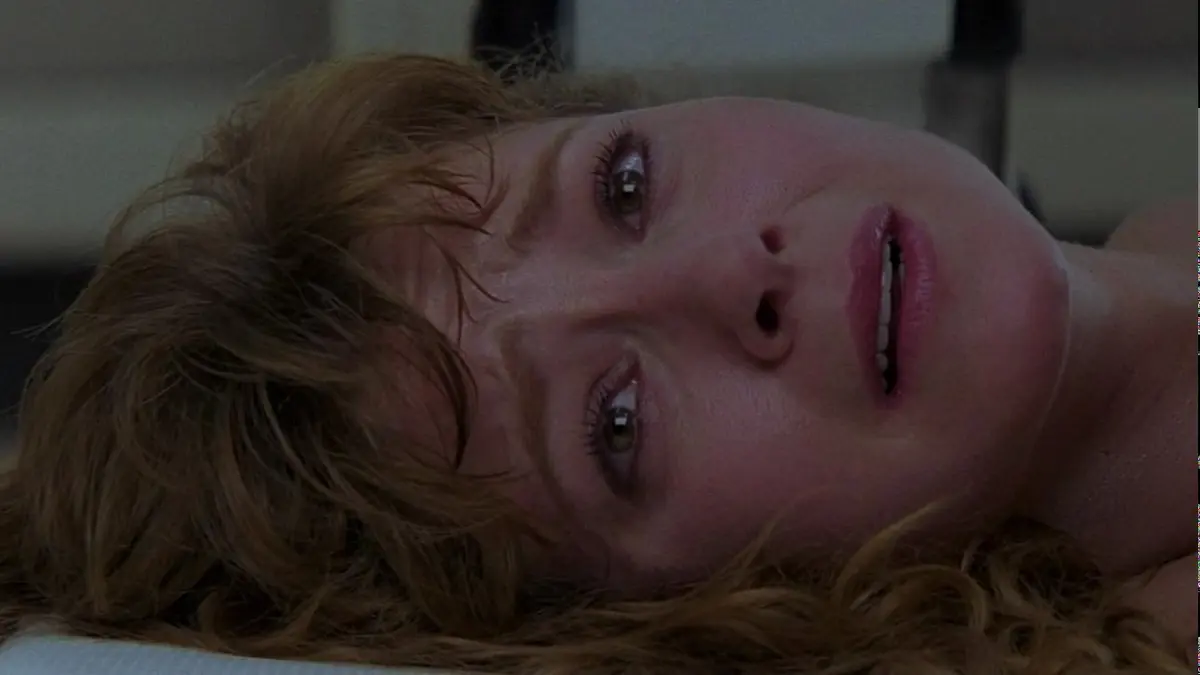
Three days until pickup has suddenly become an ambitious goal.
Please Consult the Manual Before Flushing Your Coworkers
Doc and Beck discover that Sixpack and Bowman’s bodies have merged into one pulsating mass.
There is really no management book for this.
The crew decides to place the fused bodies in a body bag and eject them through the lift lock. Talon was impressed that the station apparently stocks bags in “mutated double-coworker” size.
Then somebody points out that the manual prohibits dumping human remains into the ocean.
This delighted both hosts because somebody had to write that rule.
Somewhere in Tri-Oceanic history, something happened that required a sentence essentially reading: Please do not flush the employees.
Talon compared it to warning labels that exist only because somebody once did the exact thing manufacturers assumed no reasonable person would do, including an old coffee pot she owned that specifically warned users not to hold it over their heads.
The problem becomes more complicated when the body bag starts moving.
The crew hesitates because dumping corpses is one thing. Dumping coworkers who may technically still be alive feels less defensible.
Then a grotesque appendage tears out of the bag and claws Cobb.
Decision made.
They eject it.
Unfortunately, part of the creature is severed by the lift and remains inside the habitat. That piece begins regenerating on its own.
Doc finally puts the clues together. The Soviets were experimenting with genetic alteration, apparently trying to create a human capable of surviving underwater. The mutagen contained fish DNA and had been hidden in the vodka so the crew would consume it without knowing they were part of an experiment.
That detail makes the whole wreck considerably uglier. The Leviathan crew did not knowingly volunteer for an ambitious scientific trial. Somebody dosed the alcohol specifically because sailors would drink it, turning an ordinary vice into the delivery system for a genetic experiment. The ship was then deliberately sunk once the results became impossible to contain.
The project produced something regenerative, adaptive, and very difficult to kill.
Beck responds to the grand dream of creating Homo aquaticus by wondering whether running out of airplanes would mean scientists start growing bird people.
Doc offers the movie’s scientific conclusion:
Do not fuck with Mother Nature.
Solid peer review.
The Monster Would Also Like to Know Where You Keep the Butter
The severed piece develops into a creature and starts moving through the station.
Its first major target is DeJesus, who is in the kitchen looking for butter.
Not in the refrigerator.
In cabinets.
Several cabinets.
Talon became briefly distracted by this because whatever genetic horror is loose aboard Shack 7, somebody also needs to explain the station’s butter storage system.
The creature attacks DeJesus and begins burrowing into his chest. Jones is nearby but wearing headphones, so DeJesus has to make quite an entrance before anybody notices.
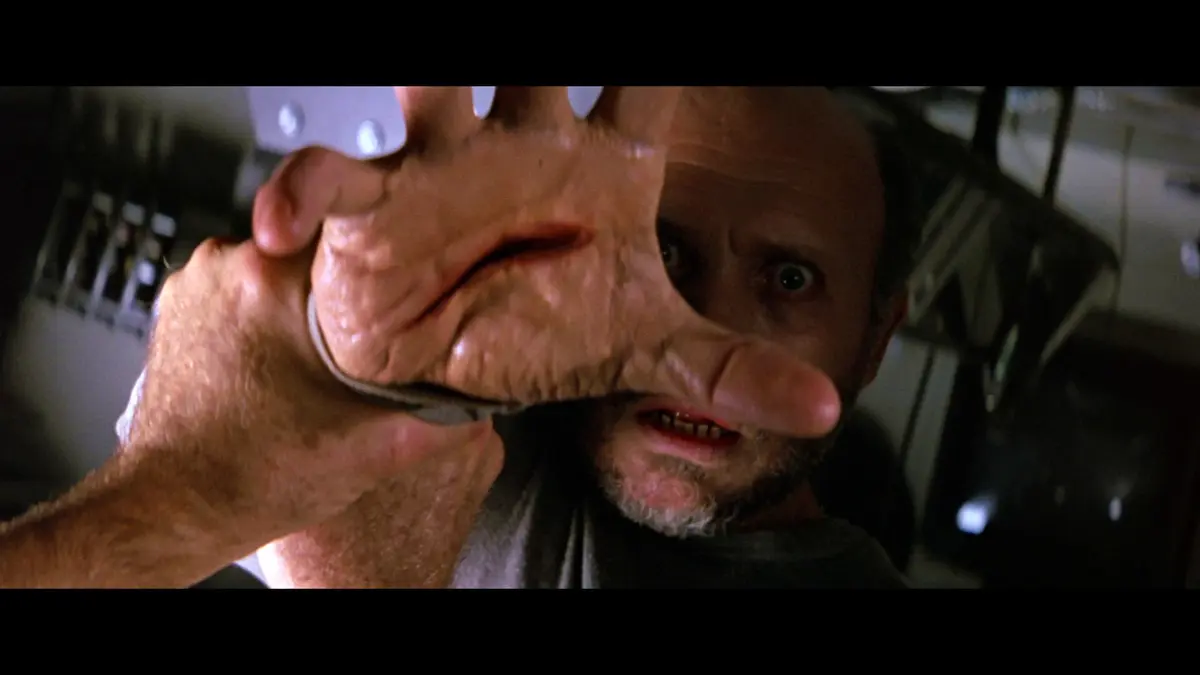
Jones seals the room and goes for help.
By the time he returns, the creature has absorbed DeJesus and chewed through an enormous steel door.
The crew arms itself with whatever an underwater mining facility apparently keeps for casual emergencies: chainsaws, drills, flamethrowers, and anything else that looks capable of discouraging mutant seafood.
The monster raids the medical bay’s blood supply, which gives Doc another disturbing insight. It needs blood to grow, regenerates rapidly, and may retain some characteristics or knowledge from the people it absorbs.
This is where the movie’s inspirations become impossible to miss.
Talon first recognized the severed creature as extremely Alien-like. Dan widened the comparison to Alien, The Thing, Event Horizon, and the whole tradition of putting a mismatched group of people in an isolated environment while something horrible works through the cast list.
Leviathan is essentially underwater Alien with pieces of The Thing, only everyone also has to answer to Human Resources from hell.
The practical effects help sell it. They sometimes look gloriously 1980s, including one mutation that gives Cobb what appears to be a tooth-filled mouth in his hand, but Dan and Talon both appreciated that the actors were interacting with physical creatures, prosthetics, sets, and effects rather than staring at empty space waiting for a computer to finish the scene thirty years later.
The creature work is not always convincing, but it has weight. Things drip, tear, bulge, fuse, and physically occupy the same cramped hallways as the actors. Even when an effect looks silly, there is at least something tangible for everybody to scream at.
Good News: The Hurricane Is Completely Fake
While the creature grows, Tri-Oceanic keeps promising rescue.
Cobb’s wound begins mutating. Doc realizes the contamination is spreading and, convinced nobody can risk carrying it to the surface, secretly launches the escape pods without the others.
His final message essentially offers the entire station as a sacrifice.
Beck, Willie, and Jones are not enthusiastic about being volunteered.
They contact Martin again.
She now claims the hurricane has become so severe rescue will take at least another forty-eight hours.
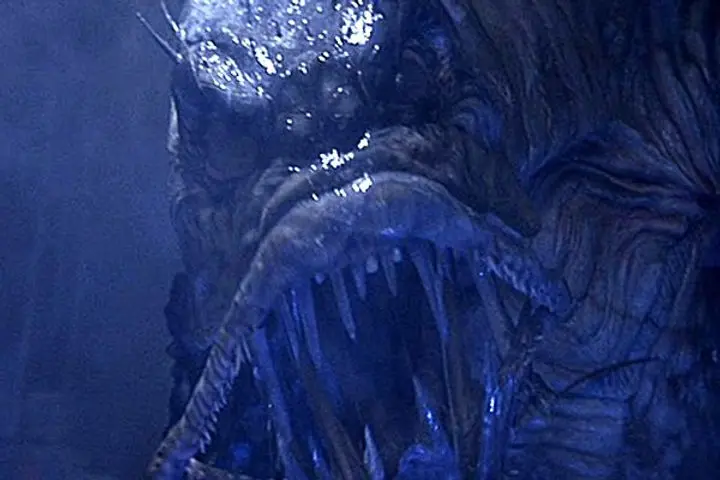
Jones reacts exactly as a person trapped with a mutant creature should react when told to get some rest.
Rest?
There may not be enough remaining lifetime for that.
Then Willie discovers the truth by checking Tri-Oceanic’s financial information.
The company has already announced that Shack 7 suffered an accident.
Every crew member is listed as dead.
Tri-Oceanic has written them off while Martin is still talking to them.
That is impressively efficient corporate betrayal. There is something particularly vicious about learning you have been declared dead by checking the stock price. The monster may be physically absorbing the crew, but Tri-Oceanic has managed to erase them from the world without leaving its office.
Even better, when the surviving crew later reaches the surface, the ocean is calm, the sky is clear, and there is not a hurricane anywhere.
Martin was never waiting for the weather to improve.
She was waiting for the problem to die quietly.
Unfortunately for Tri-Oceanic, Beck has stopped reading management books and started making decisions.
Chewing Gum Has Finally Reached Its Limit
The creature damages the station badly enough that the habitat begins losing pressure. The computer announces they have only minutes before implosion.
Jones remembers the machinery Cobb repaired earlier with chewing gum.
For one shining moment, the fate of three human beings may depend on whether the original repair used sufficiently industrial-strength bubble gum.
It did not.
Talon and Dan agreed that Bazooka Joe might have saved everybody.
The actual gum has betrayed them.
With the station collapsing, Beck, Willie, and Jones race toward the diving chamber while the creature attacks from the corridors, vents, floors, and seemingly anywhere a tentacle will fit.
They fight it with flamethrowers, improvised weapons, electricity, and a hand saw while massive safety doors begin closing around them.
Jones somehow holds one of those giant metal doors open with his body long enough for the others to pass, which suggests the real genetic experiment should have involved whatever Ernie Hudson was eating.
Eventually Willie and Jones get into the deep-sea suits and begin their ascent. Beck stays behind long enough to fight his way free, suits up, and escapes seconds before Shack 7 collapses into itself.
All three reach the surface.
The sky is beautiful.
No hurricane.
They have actually made it.
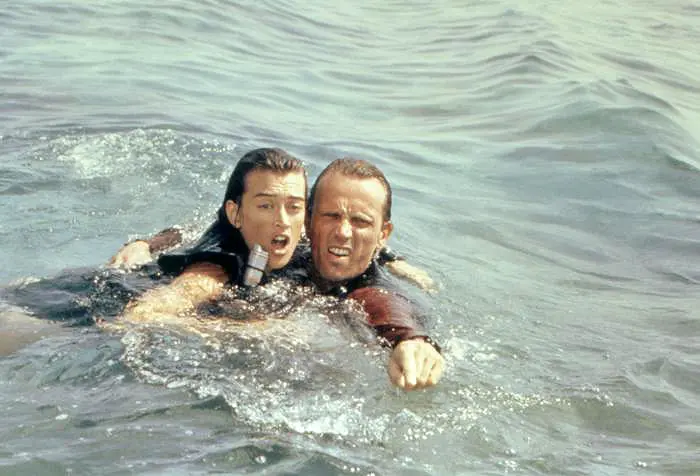
Then sharks arrive.
For a brief moment, Talon and Dan became convinced the movie was going to perform the familiar horror trick of finally killing Jones, the Black character.
The sharks leave.
Jones survives.
There was celebration.
Then the mutant erupts from the water.
Jones throws himself into the fight to protect Willie, and after surviving almost the entire movie, he is killed within sight of rescue.
So close.
Beck tosses a flare into the creature’s mouth, and it somehow explodes as though he had thrown a grenade. He and Willie are pulled aboard the Coast Guard helicopter.
Two survivors remain.
And one corporate executive is about to have a very bad afternoon.
The Verdict
Dan gives Leviathan 6 cents out of 10.
He had seen it years earlier and remembered pieces of it, especially the ending, but thought it held up as an enjoyable example of the era. It does not do much that Alien, The Thing, and similar isolated-creature movies had not already done better, but the cast sells the material, the practical effects give it personality, and the movie understands what kind of creature feature it wants to be.
Talon also gives Leviathan 6 cents out of 10.
She had never seen it during the 1980s and thought she probably would have found it genuinely scary as a kid. Watching it now, she saw it more as an entertaining piece of ’80s horror: not especially frightening, not remotely an Oscar contender, but easy to watch and fun to revisit.
She especially liked the cast, including Peter Weller, Hector Elizondo, and Ernie Hudson, whose presence can make even a cheesy movie substantially easier to enjoy.
Both hosts also appreciated the practical effects. Some have aged better than others, but there is something satisfying about seeing actors struggle against an actual creature effect instead of pretending the monster will eventually be added somewhere over their left shoulder.
And then there is the ending.
Beck and Willie are delivered to a Tri-Oceanic platform, where Martin greets them with the warm smile of a woman who definitely did not already publish their obituaries.
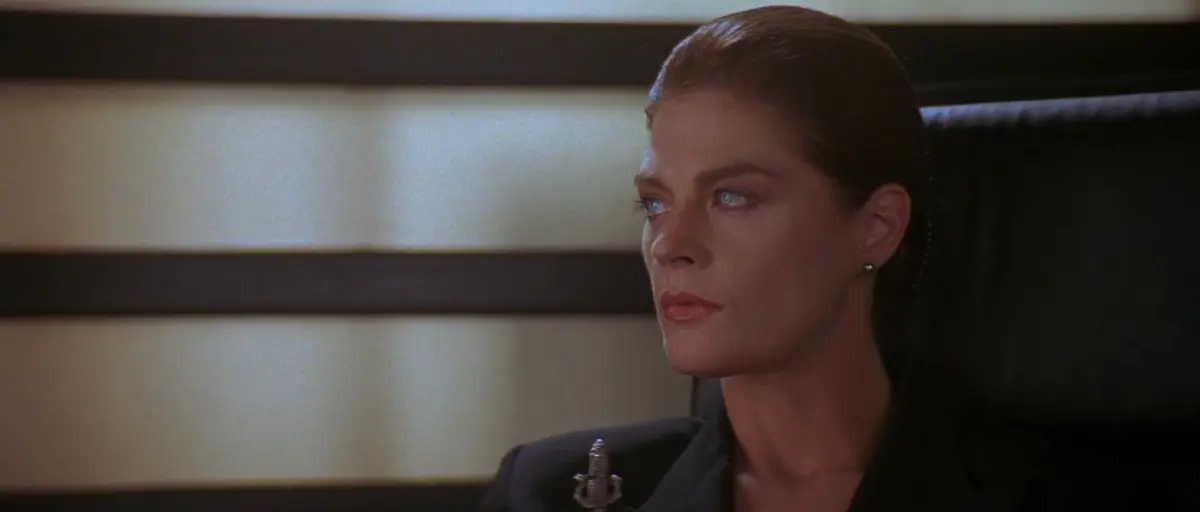
She tells Beck she always knew he would make it.
Then she asks how he feels.
Beck punches her square in the face.
“Better. A lot better.”
After ninety days underwater, several dead coworkers, one Soviet fish mutation, a fake hurricane, an attempted corporate cover-up, and the complete failure of chewing gum as structural engineering, Leviathan finally gives us something universally therapeutic.
Sometimes self-care is punching corporate bullshit directly in the mouth.