The Burning (1981): When Slashers Go to Summer Camp
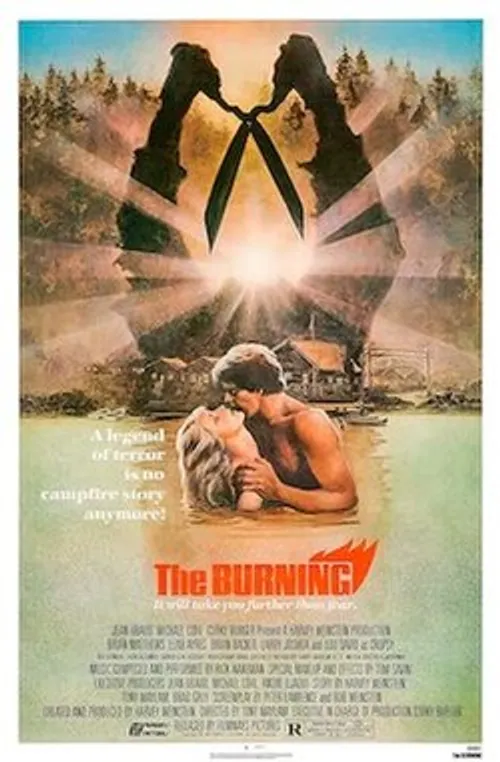
There’s something oddly comforting about a straightforward slasher movie. No grand metaphors, no psychological depth—just a simple premise executed with varying degrees of competence. The Burning falls squarely into this category, delivering exactly what you’d expect from an early-80s summer camp massacre with enough nostalgia and ridiculous moments to make it genuinely entertaining.
What makes The Burning particularly interesting isn’t the plot—it’s the behind-the-scenes context. This is a Weinstein brothers production (yes, those Weinsteins), inspired by the urban legend of Cropsey that circulated around New York. It’s also the film debut of Jason Alexander, Fisher Stevens, and Holly Hunter, which is genuinely shocking when you’re watching what you assume is a B-list slasher and suddenly recognize future stars among the cannon fodder teenagers.
The premise is classic revenge horror. Five years ago, a group of boys at Camp Blackfoot decided to prank the mean-spirited caretaker Cropsey by sneaking a skull covered in worms with candles in the eye sockets into his cabin. Because apparently that seemed like a proportional response to him being kind of a dick. The prank goes catastrophically wrong when Cropsey freaks out, knocks the skull onto himself, and immediately bursts into flames from two tiny birthday candles.
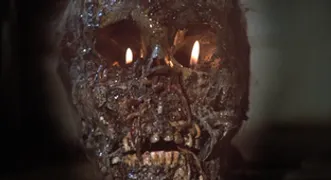 He then proceeds to kick over a conveniently placed can of gasoline beside his bed, because everyone keeps industrial quantities of accelerant in their bedroom.
Flash forward five years. Cropsey’s been in the hospital getting skin grafts, none of which took particularly well, and he’s understandably still pissed about the whole being-set-on-fire thing. Despite doctors telling him to let go of his anger and not seek revenge, he promptly leaves the hospital, picks up a sex worker, and murders her with giant garden shears just to get warmed up. Then he heads to Camp Stonewater, where coincidentally one of the boys involved in the original prank is now a counselor.
The movie spends a lot of time establishing camp life, and this is where the 80s vibes hit hard. Kids are smoking cigarettes—including what looks like an 11-year-old—and passing them around like it’s no big deal. Everyone’s trying to hook up with everyone else, and the camp counselors seem to actively encourage it. There’s an uncomfortable amount of gratuitous nudity of characters who are supposed to be teenagers, even if the actors were adults. It’s peak Harvey Weinstein-era filmmaking, which means there’s also a deeply uncomfortable rapey vibe to several scenes that definitely wouldn’t fly today.
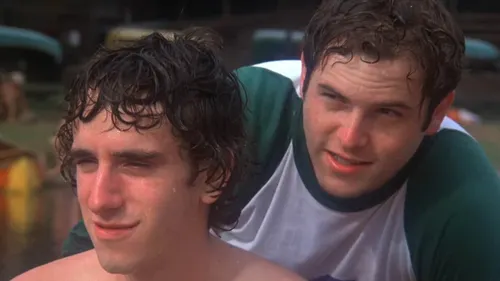
The cast of characters includes the standard slasher archetypes: Todd the heroic counselor, Michelle the responsible one, Eddie the horny guy obsessed with Karen, Glazer the bully who likes Sally, and Alfred, the nerdy loner kid who keeps putting himself in situations that make him look like a creep. Alfred spies on girls in the shower, watches couples making out from behind trees, and generally acts suspicious enough that the movie tries to make you think he might be the actual killer.
The film also features some genuinely baffling moments. There’s a scene where a girl is playing softball in a bikini bottom. Glazer wears red jogging shorts hiked up so high they might as well be a Speedo, giving himself what had to be the world’s most uncomfortable wedgie. And every single person in this movie has the flattest ass you’ve ever seen, with the possible exception of Jason Alexander.
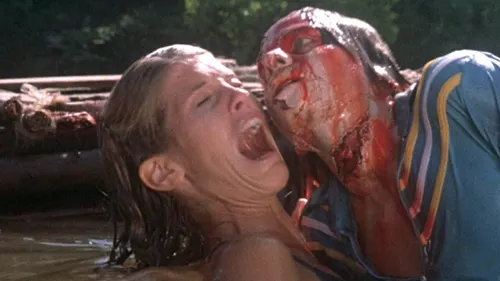
When the killing finally starts, it’s a mixed bag. Tom Savini handled the special effects, and he famously chose this film over Friday the 13th Part 2 because he thought Jason surviving after drowning as a child was illogical. Which is a weird hill to die on when you’re making slasher movies, but okay. The infamous raft massacre scene where Cropsey somehow hides in a canoe, stands up without tipping it over, and slaughters five kids while wearing a full trench coat and hat was graphic enough to land the film on the UK’s video nasties list.
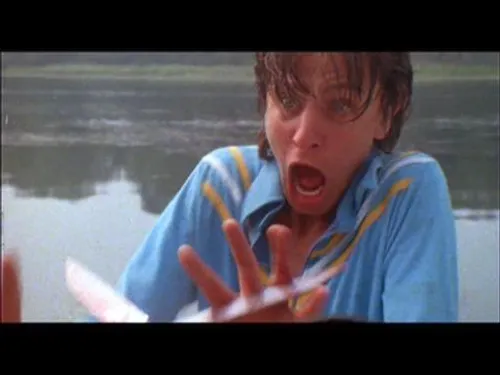
But here’s the problem: so much of the violence happens in near-total darkness. We’re talking can’t-see-a-damn-thing levels of darkness. Whether you watch it during the day or at night with blackout curtains, huge chunks of this movie are incomprehensibly dark. The climactic scenes in the abandoned mine are especially bad. You can barely make out what’s happening half the time.
That said, the movie does pull off a few effective moments. The extended sequence of Todd wandering through pitch-black corridors actually builds genuine tension because it subverts your expectations. You keep anticipating a jump scare that never comes, so when Cropsey finally does appear, it actually works. It’s a rare case where what might be tedious pacing accidentally creates effective scares.
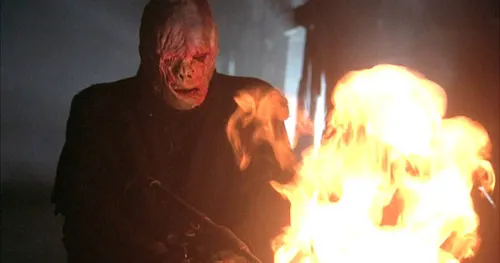
The final act takes place in what appears to be an abandoned mine that looks suspiciously like the same location shot from multiple angles to seem bigger than it is. Alfred runs and runs and runs (this island is apparently massive) until he finally gets cornered. In a weird choice, Cropsey doesn’t immediately kill Alfred like he did everyone else. Instead, he pins Alfred’s arm to a wall with the shears and just… leaves him there. It feels like the movie trying to set up Alfred as either secretly working with Cropsey or being revealed as the real killer, but that never happens. He’s just a weird kid who gets spared for plot convenience.
Todd eventually has a flashback revealing he was one of the original prankster boys, which makes Cropsey’s revenge plot make slightly more sense. There’s a prolonged confrontation where Todd swings an axe with absolutely no authority whatsoever, like he’s letting the weight of the axe head do all the work, while Cropsey casually leans left and right to avoid it. Eventually Alfred frees himself, stabs Cropsey in the back of the neck, and when Cropsey inevitably gets back up for one last scare, Alfred buries an axe in his head and sets him on fire. Twice-baked Cropsey.
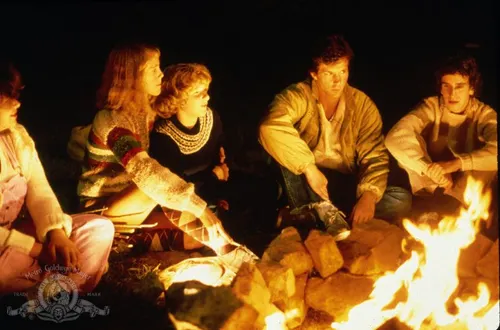
The film ends with a new group of campers hearing the Cropsey legend around a campfire, suggesting the cycle continues.
The Burning isn’t trying to reinvent the slasher genre. It’s a product of its time—rapey undertones, unnecessary nudity, questionable decisions, and all. But there’s something enjoyable about its straightforward approach. It doesn’t pretend to be profound. It’s just kids at camp getting murdered by a disfigured maniac with garden shears, filmed with enough competence to be entertaining and enough absurdity to be memorable.
The acting ranges from decent to not-so-much, but it’s fun spotting future stars in their first roles. The special effects were groundbreaking for their time, even if they don’t hold up by modern standards. And despite the frustrating darkness and some truly baffling character decisions, there’s genuine entertainment value here. Watching it now requires looking at it through an 80s lens, accepting that what passed for normal then is deeply uncomfortable now, appreciating the practical effects that paved the way for modern horror, and embracing the nostalgic absurdity of summer camp slashers.
The Burning works as a time capsule of early-80s horror when slasher movies and campground settings were having a moment together. It’s not reinventing anything, but it doesn’t need to. Sometimes you just want a non-thinking slasher movie where you can turn your brain off and watch teenagers make terrible decisions in the woods. For that specific purpose, The Burning delivers.
We’re giving it six to six and a half cents out of ten. It’s definitely not the best slasher ever made, but it’s miles ahead of sitting through June 9 again. It has entertainment value, some genuine scares, and enough ridiculousness to keep things interesting. Plus, it’s kind of wild seeing a baby-faced Jason Alexander surviving summer camp to go on to greater things.
Not a masterpiece, but a perfectly serviceable slice of slasher nostalgia with enough charm to make it worth the watch.