The Raft (1987): Childhood Trauma, Cold Water, and One Immortal Car Battery
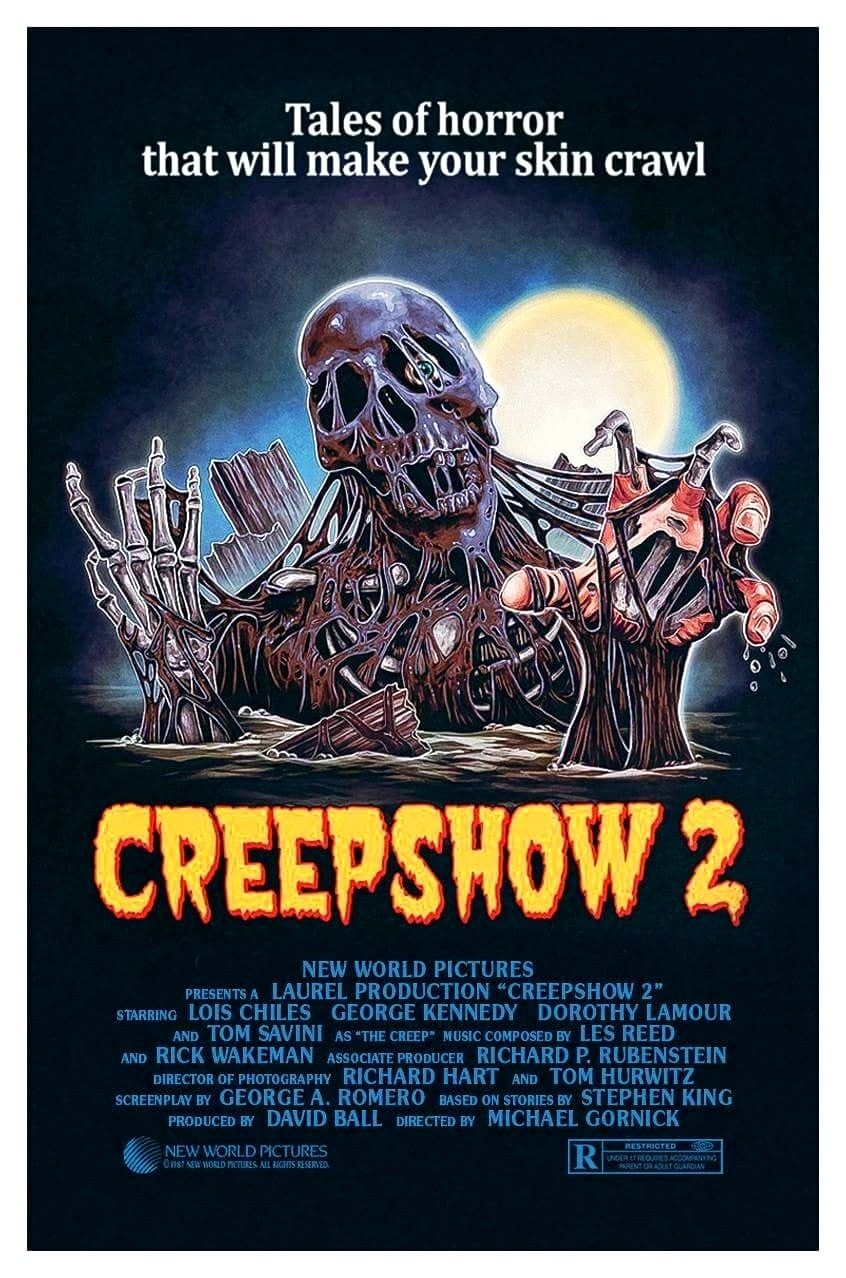
Some childhood fears fade with time. Others spend several decades hiding beneath a dock, waiting for you to climb a ladder.
The Raft, the middle story in 1987’s Creepshow 2, is responsible for the second kind. It gave both of us a lifelong distrust of floating platforms, murky lake water, and anything that resembles an oil slick but moves with suspicious purpose. Watching it again as adults revealed something else: the monster is still effective, but the humans have become considerably harder to defend.
The story begins with four college students driving roughly fifty miles into the middle of nowhere for an off-season swim. There is Deke, the loud jock; Laverne, his equally loud girlfriend; Rachel, who looks as though she may have been brought along against her will; and Randy, the allegedly sensible one. We say allegedly because Randy’s reputation will not survive the morning.
They arrive at Cascade Beach in mid-October, leave both doors of Deke’s Camaro hanging open, leave the music playing, and head for a raft sitting in water cold enough to make Randy warn that it could stop their hearts. Nobody treats this as a reason to reconsider. Apparently, if you have already driven fifty miles and somebody packed weed in a waterproof container, hypothermia becomes more of a suggestion.
That Is Not an Oil Slick
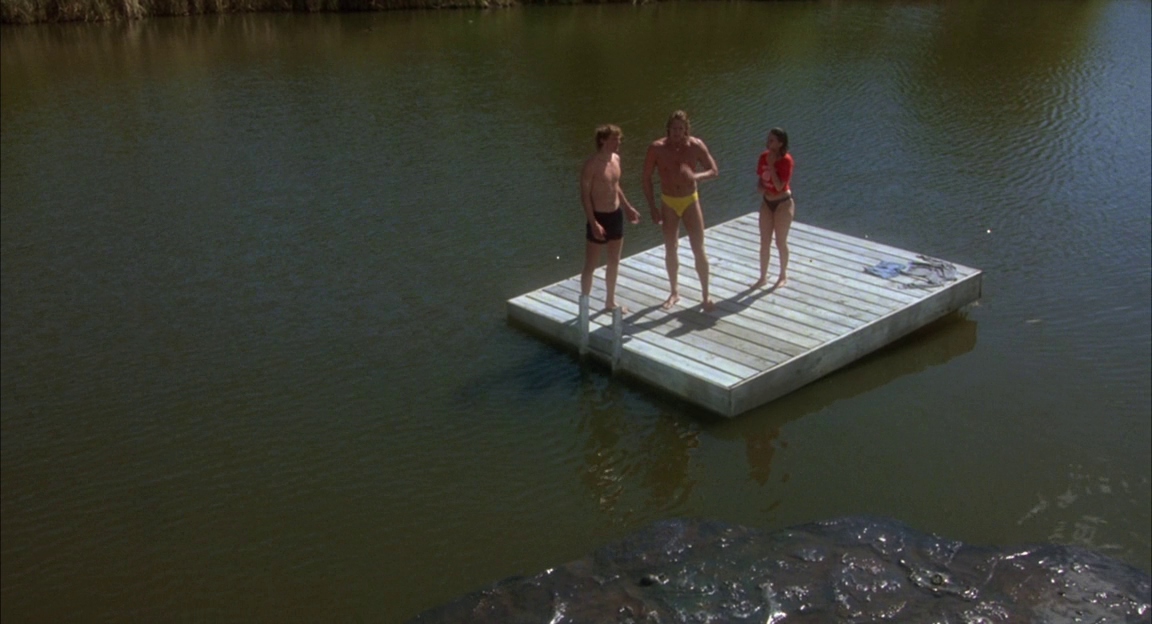
Deke strips down to a pair of extremely yellow Speedos and charges into the lake. The others follow, with Laverne struggling behind in the freezing water. Randy is the first to notice a black mass on the surface. Then he sees a duck fighting to escape it before being pulled underneath.
This would be enough information for most people. Randy screams for everyone to swim faster, but once they reach the raft, the group settles in to debate whether the moving, duck-eating substance is really dangerous. Deke has even managed to keep a joint and lighter dry inside a small container attached to his Speedos, which may be the most competent decision anyone makes in the entire story.
Rachel becomes fascinated by the shimmering colors in the mass and reaches down to touch it. The creature immediately climbs her arm, dissolves her flesh, and drags her into the lake while the others watch. It is fast, hungry, and capable of moving exactly where it wants. Whatever this thing is, “oil slick” is no longer a sufficient explanation.
The survivors finally confront the problem they should have considered before leaving civilization: nobody knows where they are. The lake is closed for the season, the caretaker is gone, and their car might as well be on the moon. The only route back is through the water.
The Raft Has Opinions
Deke believes he can outswim the creature. It is not the worst theory. He is the strongest swimmer, the shore is visible, and the thing has just eaten Rachel. Maybe it is full. Maybe it will chase the slowest person. Maybe the yellow Speedos provide some kind of aerodynamic advantage.
Before he can try, the creature oozes between the wooden slats, catches his foot, and begins pulling him through the raft.
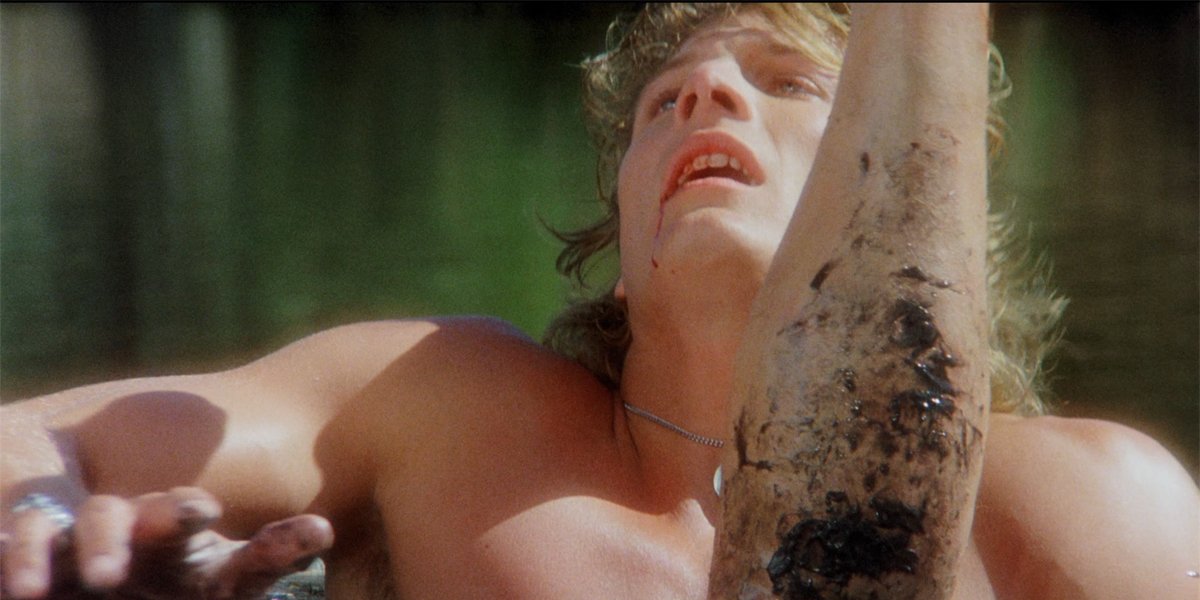
This is the death people remember. Deke’s leg bends, stretches, and disappears through a gap that seems to grow large enough to accommodate the rest of him. The practical effects are gruesome, but there is also a continuity miracle happening beneath all that carnage. Once Deke is gone, the raft appears to repair itself. The enormous opening required to drag a full-grown man through the boards becomes an ordinary little crack again, because apparently the lake monster came with a maintenance agreement.
That leaves Randy and Laverne balancing on the remaining boards while the creature circles underneath them. Every shift of weight creates another opportunity for it to push through. Day becomes night, the temperature drops, and the two of them try to stay awake while watching opposite sides of the raft.
This portion still works remarkably well. There is no elaborate plan and no weapon waiting to be discovered. They are cold, exhausted, and stuck on a few pieces of wood while something patient waits beneath them. The simplicity is what makes it frightening.
Randy Ruins Randy
By morning, Randy and Laverne have fallen asleep together. Randy wakes first and decides that the appropriate response to surviving a night beside two freshly eaten friends is to start touching Laverne while she is unconscious.
As children, neither of us remembered this part. As adults, it changes the entire character. Randy had been positioned as the cautious, observant one—the closest thing the story had to a decent person. Then the movie makes him predatory for no reason beyond a particularly ugly strain of 1980s horror logic. It is not romantic, it is not mutual, and it makes what happens next feel less like random tragedy and more like the story clearing the board.
While Randy is distracted, the creature pushes through the raft and catches Laverne by the face. Randy tries to hold her, but she is pulled into the water. The moment she is gone, he finally does what we have been yelling at him to do: jump in and swim.
Unfortunately, Randy swims with his head above the water in something slightly more advanced than a dog paddle. Yes, the lake is brutally cold. Yes, panic destroys technique. But if a sentient garbage bag is gaining on you, this is the moment to put your face down and discover your inner Olympian.
He barely reaches shore, drags himself onto the ground, and stops to celebrate. “I beat you,” he announces to the creature, while still sitting approximately three feet from the water.
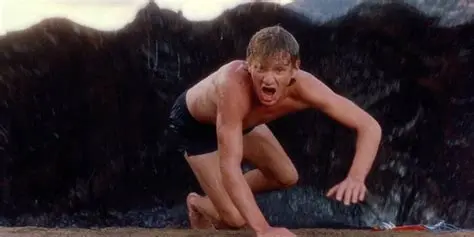
The creature rises out of the lake like an enormous black wave, crashes over him, and pulls him back in. Randy did technically reach the shore. He simply confused reaching safety with remaining beside the thing trying to eat him.
The Battery That Would Not Die
The creature settles back into the lake as the camera pans toward the abandoned Camaro. The doors are still open. The music is still playing. After an entire day and night, that battery has not weakened, sputtered, or shown the slightest concern.
Forget the monster. We want the brand name of that battery.
The camera then reveals a “No Swimming” sign almost completely hidden by overgrowth. It is a perfect final joke, although the park’s maintenance department shares some responsibility here. If a carnivorous lake slick lives on the property, trimming the vegetation around the only warning sign feels like the bare minimum.
The Verdict
As children, we both would have given The Raft a full ten cents. The creature, the body horror, and the helplessness of being surrounded by water lodged themselves permanently in our brains. Talon still has to psych herself up before approaching a dock ladder from the water, even when she knows perfectly well there is nothing beneath it.
As adults, the scores drop. The effects and central premise still work, and nostalgia gives the story power that a first-time viewing might not have. But the characters make baffling choices, the raft heals itself whenever the plot requires it, and Randy’s assault of Laverne casts a shadow over the final act.
Talon gives it six cents. Dan gives it seven. Childhood us remains unmoved at ten—and would like everyone to stay away from the underside of the dock.